
Type Conversions in JavaScript

Type conversion, also known as type coercion, is the process of converting one data type to another in JavaScript. It's a crucial aspect of the language, as JavaScript is dynamically typed, meaning variables can hold values of any type. This flexibility allows for powerful and concise code, but it also requires an understanding of how JavaScript handles different types and conversions between them.
In this article, we'll explore three common types of conversions in JavaScript: String Conversion, Numeric Conversion, and Boolean Conversion. Understanding these conversions will help you write more robust and predictable code.
✅String Conversion
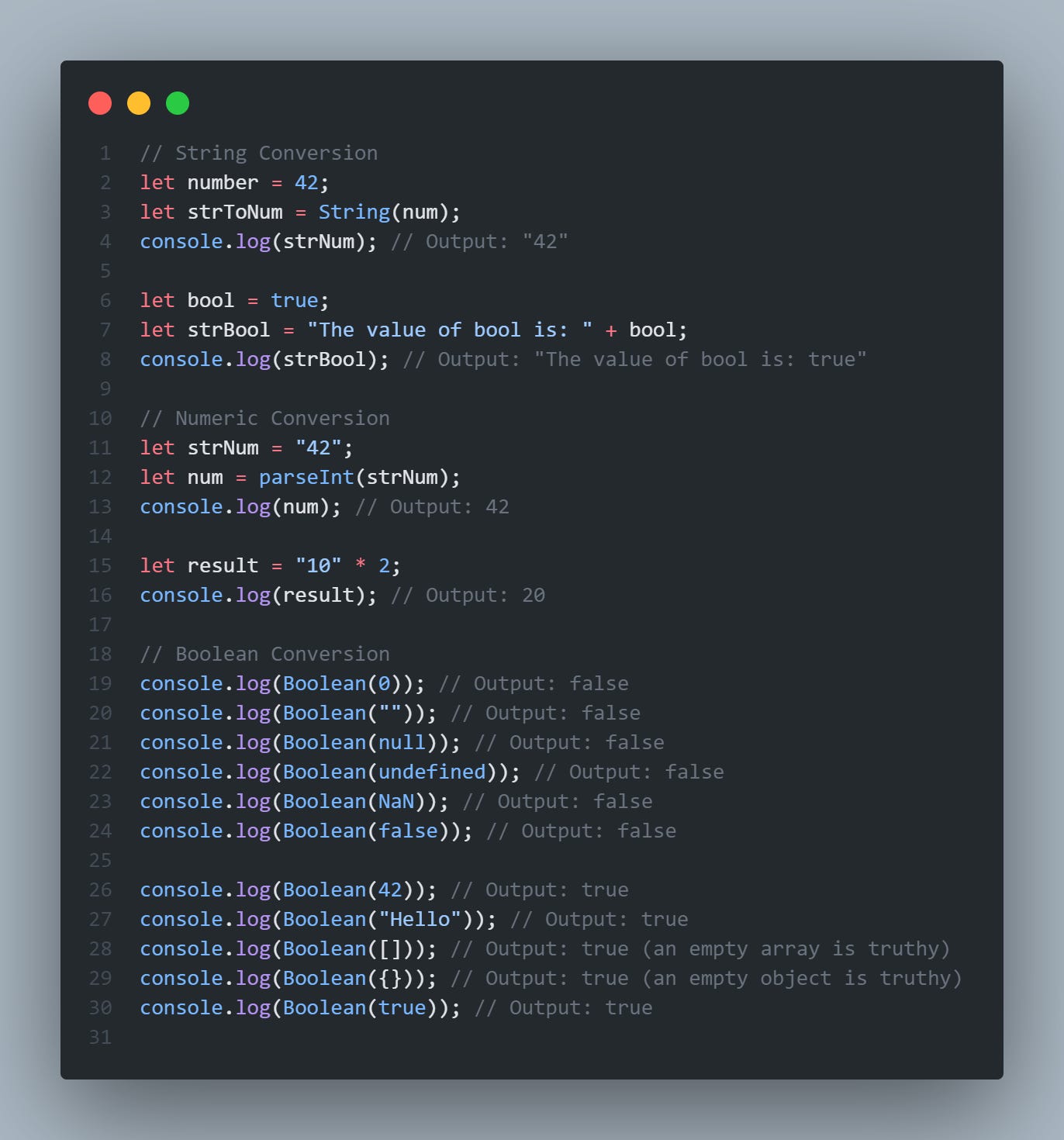
String conversion in JavaScript occurs when a value of another type is converted to a string. This conversion can happen explicitly using the String() function or implicitly in certain contexts, such as concatenating a string with another data type.
In string conversion, JavaScript automatically converts other data types to strings when they are used in a string context, such as with the + operator for concatenation.
✅Numeric Conversion
Numeric conversion in JavaScript involves converting values to numbers. This can be achieved explicitly using functions like parseInt() or parseFloat(), or implicitly when performing arithmetic operations or comparisons.
JavaScript tries to convert values to numbers when they are used in numeric contexts, such as arithmetic operations (+, -, *, /) or comparisons (>, <, >=, <=).
✅Boolean Conversion
Boolean conversion, also known as truthy and falsy conversion, determines whether a value is considered "truthy" or "falsy" when converted to a boolean. In JavaScript, all values have an inherent truthiness or falsiness.
In JavaScript, values like 0, an empty string "", null, undefined, NaN, and false are considered falsy, while all other values are considered truth.
Understanding type conversions in JavaScript is essential for writing clear and predictable code. Whether you're explicitly converting types using functions like String() or parseInt(), or relying on implicit conversions in various contexts, being aware of how JavaScript handles different data types will help you avoid unexpected behavior and write more robust applications.
THANKS FOR READING.